


Markets stall; mining difficulty +14%; EF unveils 2026 roadmap.
This week has witnessed a tumultuous phase in the cryptocurrency world, as markets stalled while investors locked in losses. Bitcoin mining difficulty experienced a notable jump of 14%, and the Ethereum Foundation unveiled an updated roadmap that has drawn significant attention. Here’s a closer look at the key highlights of the week.
Markets in the Red
The cryptocurrency landscape has remained stagnant, with the prevailing momentum leaning towards negative. In the past week, Bitcoin declined by approximately 4%, marking a staggering 25% drop over the past month. On Monday, Bitcoin was trading around $70,000 but plummeted to a local low of nearly $65,000 by Thursday. By Sunday, it managed to regain some ground, closing at around $67,000.
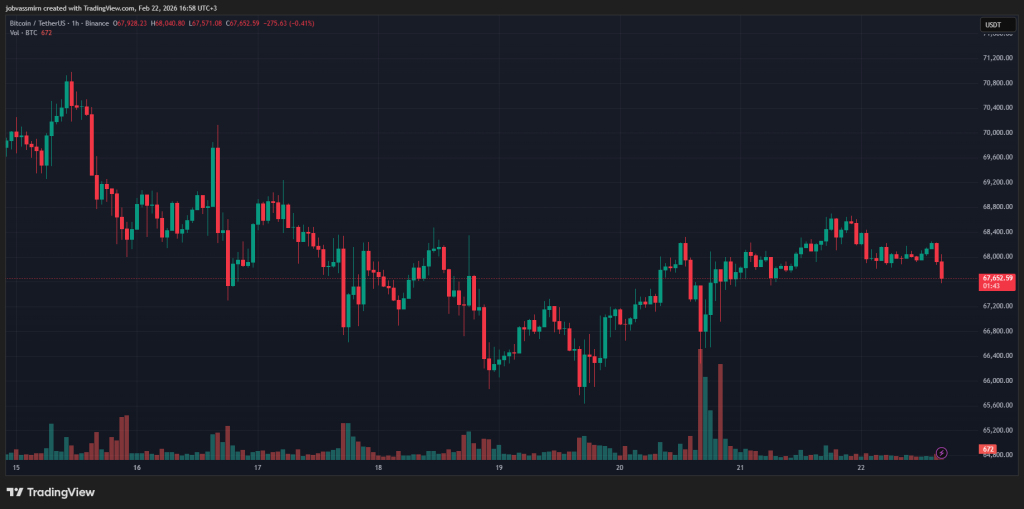
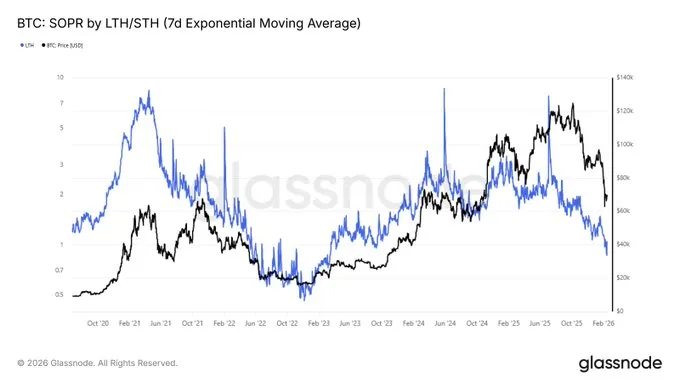
Ethereum mirrored Bitcoin’s trajectory, struggling to maintain the psychological threshold of $2,000 and experiencing a 5.5% decrease over the week. Analysts at Glassnode pointed out that a price drop to $60,000 exerted psychological pressure on long-term holders, similar to the collapse of the Terra ecosystem in May 2022.
According to Glassnode’s analysis, the seven-day exponential moving average of the Spent Output Profit Ratio (SOPR) for long-term investors fell below 1, indicating that they began selling at significant losses—a behavioral trend typically observed in deeper bear-market conditions. Furthermore, inflows to trading platforms have lessened drastically, as many professional investors pivot towards more liquid assets or increase their cash reserves.
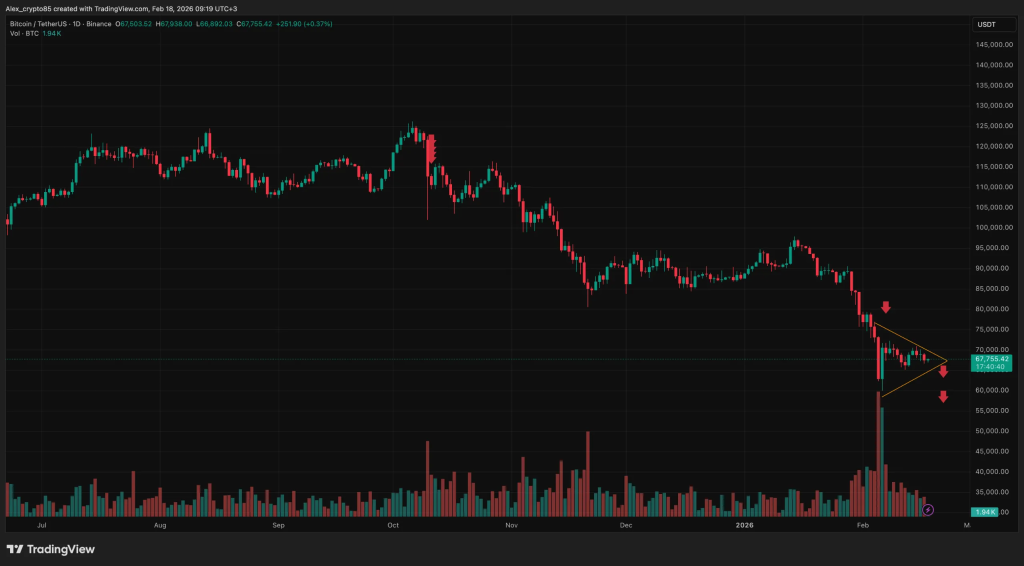
This trend is reflected in the US spot Bitcoin ETFs, which have faced outflows for five consecutive weeks. Technical analysts have identified a “bear pennant” formation in Bitcoin and Ethereum, suggesting price targets of $55,000 and $1,100, respectively.
The Crypto Fear and Greed Index remains near lows, currently at 9, reflecting the market’s sentiment amidst declining total crypto market capitalization, which has remained at $2.45 trillion, with Bitcoin dominance resting at 56.6% and Ethereum at 9.8%.
Mining Difficulty on the Rise
This week brought a significant update in Bitcoin mining, with the mining difficulty increasing by 14.73% to 144.4 T. This adjustment is among the most substantial changes witnessed since 2021. In contrast to the previous adjustment, which saw a decrease of 11%, this recent rise comes as many miners had momentarily halted operations due to severe weather affecting network hashrate.
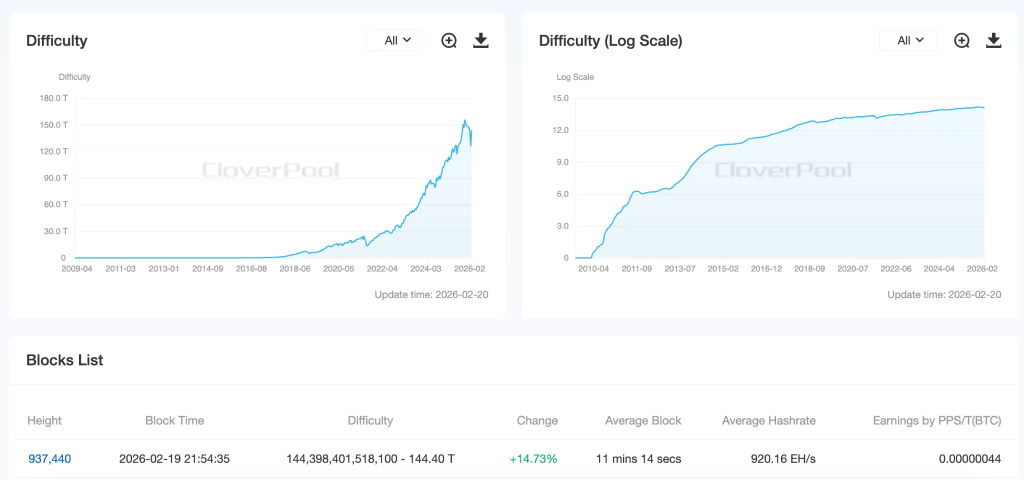
Following this adjustment, the network hashrate is above 1 ZH/s, demonstrating a recovery after a slight dip. However, hashprice continues to decline, dropping from $34 to $28 per PH/s per day. Even with profitability decreasing significantly, some operators with access to affordable energy continue to scale up operations. For instance, the UAE’s unrealized profit from Bitcoin mining has reached $350 million.
Conversely, companies like Bitdeer have taken a different approach by offloading their Bitcoin reserves entirely. Bitdeer recently sold 943.1 BTC, illustrating the diverse strategies companies are adopting amidst the shifting market dynamics.
Thoughts for Discussion
- OpenAI released a benchmark assessing AI agents’ capability to hack smart contracts.
- Keyrock researchers suggest that US treasuries affect Bitcoin’s price more significantly than the Fed’s actions.
- The Sharpe ratio indicates a potential near-term Bitcoin recovery.
- A staggering 85% of tokens launched in 2025 fell below their initial price.
Plans to Safeguard Ethereum
The Ethereum Foundation (EF) recently updated its protocol roadmap for 2026, emphasizing three main areas: scaling, improving user experience (UX), and safeguarding the base layer.

In terms of scaling, developers aim to enhance layer-one throughput and data availability with goals such as:
- Incrementally raising the gas limit to 100 million and beyond, facilitated by block-level access lists and routine client performance assessments.
- Preparing for the upcoming Glamsterdam hard fork, which intends to incorporate a built-in PBS mechanism and reassess operational costs.
- Launching an attester client based on zkEVM in readiness for full mainnet functionality.
- Storage optimization efforts, including pruning outdated data and adopting binary trees for statelessness architecture.
On the UX front, the focus is shifting towards native account abstraction and cross-chain interactions. Developers are hopeful that recent implementations, including EIP-7702, will ease the process of utilizing smart-contract wallets without intermediaries. Future steps include embedding smart-account logic directly into the protocol with subsequent EIPs.
Militarised AI in Focus
In a groundbreaking move, the Wall Street Journal reported that the US military utilized Anthropic’s Claude AI chatbot in an operation to capture Venezuela’s President Nicolás Maduro. This news raised questions about the ethical implications of employing AI in military operations, particularly given that Anthropic’s policies explicitly prohibit using AI for violent or surveillance purposes.
“We cannot comment on whether Claude or any other model was used in any specific operation—classified or otherwise,” stated a company representative.
The allegations have caused ripples in the relationship between Anthropic and the military, leading to a review of their partnership. Meanwhile, sources revealed that the military is pressing several major AI companies, including OpenAI and Google, to allow their technologies for lawful military use. This is framed against the backdrop of significant contracts, wherein companies like SpaceX and xAI pursue contracts to develop advanced military technologies.
Crypto Payments in Belarus
In a positive development for freelancers, Belarus has officially legalized cryptocurrency payments for self-employed workers. This change allows individuals in the country to receive payment for services rendered in cryptocurrency without the grey-area complexities that previously existed.
“Blockchain technology, combined with state regulation, ensures a level of transparency that ordinary banks could only dream of,” remarked Alexander Yegorov, chairman of the National Bank of Belarus.
Crypto-banks will facilitate these transactions, providing essential services to ensure a smooth transition for users wishing to move into the digital currency ecosystem.
Stay engaged with these unfolding stories, and keep abreast of the ever-evolving landscape of cryptocurrency and blockchain technology!
Found a mistake? Select it and press CTRL+ENTER
ForkLog Newsletters: Stay ahead in the bitcoin industry!