


Bitcoin’s Evolution and Wall Street’s Embrace
Bitcoin, once the symbol of rebellion against centralized finance, has seen an unexpected embrace from Wall Street. Institutions that once viewed cryptocurrencies with skepticism are now actively engaging in their ecosystems. This shift raises an intriguing question: has Bitcoin strayed from its original ethos? While Bitcoin’s rise continues, a new contender has emerged: Bittensor. This innovative project aims to “give the finger” to centralization in a world increasingly dominated by artificial intelligence (AI). The narrative around Bittensor has gained traction, representing a potential shift in the balance of power as AI becomes more prevalent.
Bittensor: The Next Generation in AI and Cryptocurrency?
Bittensor, along with its cryptocurrency TAO, seeks to decentralize the services associated with AI. Despite a challenging year in 2025 where its value dropped by nearly 53%, some enthusiasts are optimistic that Bittensor could emerge as a next-generation Bitcoin in this AI-centric age. But how grounded is this enthusiasm?
The Premise and Promise of Bittensor
On December 15, 2025, Bittensor underwent a reward halving, reducing its daily minting from 7,200 TAO to 3,600. While the halving might remind some of Bitcoin’s early days, skepticism remains. Many cryptocurrencies have labeled themselves as “the next Bitcoin,” yet only a few have demonstrated real long-term value.
The narrative of Bittensor shares parallels with Bitcoin’s early journey: both face powerful incumbents, and both present the potential to disrupt existing power structures. For years, the refrain “long Bitcoin, short the banks” permeated the crypto discourse; now, this sentiment resonates differently as Bitcoin gains acceptance in mainstream finance.
Bittensor addresses growing concerns about the size and power of leading AI companies like OpenAI and Anthropic. As these entities expand, many believe it’s crucial to insist on a diversification of power in the field of AI. Essentially, the goal of Bittensor is to depreciate the reliance on proof-of-work mechanisms, instead leveraging genuine AI tasks to create value.
“Bitcoin proved that cryptographic incentives could coordinate a global network of hardware to secure a ledger,” says Evan Malanga, an executive at Yuma, a significant backer of Bittensor. “Bittensor takes that same mechanism and redirects the compute power toward something that has direct benefits in today’s world: Training and running AI models, applications, and infrastructure.”
Another Bitcoin? Really?
It’s crucial to note that Yuma is a subsidiary of Digital Currency Group (DCG), which has a rich history in cryptocurrency investing, backing several prominent projects, including Bitcoin and Zcash as well as platforms like Coinbase. With Barry Silbert, DCG’s CEO, backing Bittensor, some view this as a reliable validation of its potential.

Bittensor mirrors some of Bitcoin’s traits: it has a capped supply of 21 million TAO, reminiscent of Bitcoin’s scarcity model, alongside a structure of halvings. Rather than relying on energy-intensive proof-of-work algorithms, Bittensor uses proof-of-intelligence, rewarding nodes based on the quality of their AI tasks.
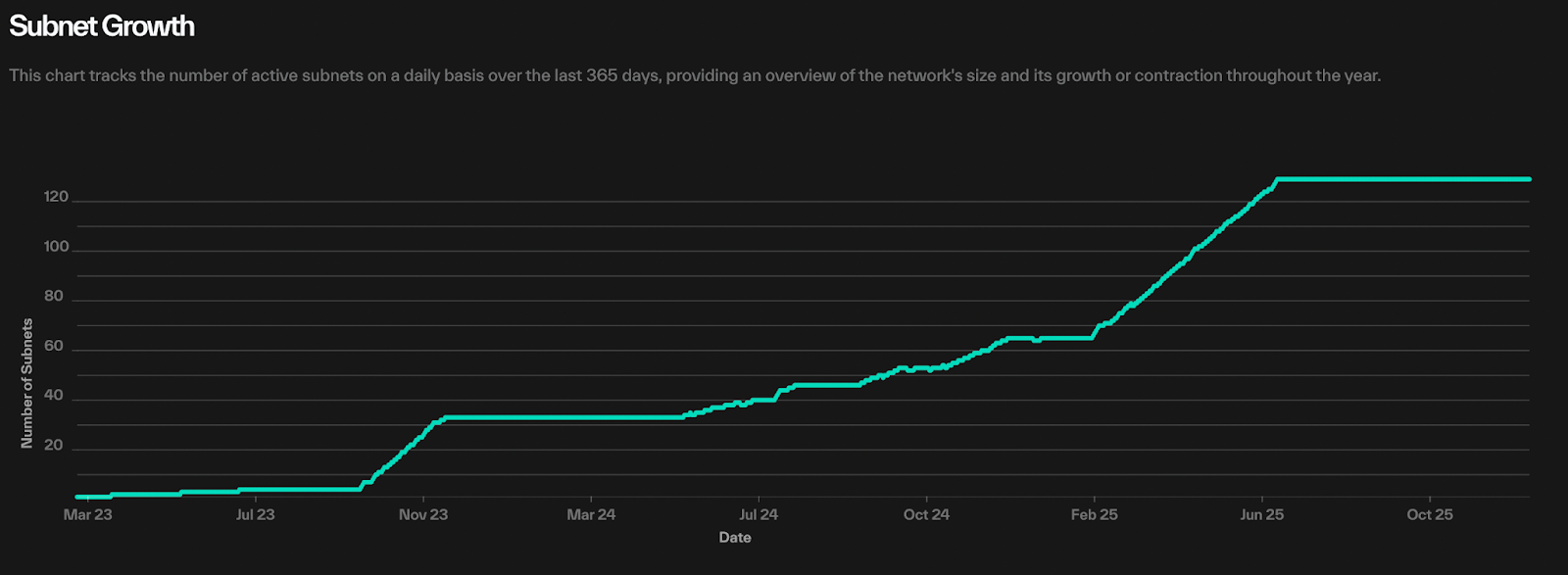
Nodes joining the Bittensor network are distributed across 128 distinct subnets, each specializing in different AI-related functions, from image recognition to language processing.
“Each subnet is like a specialized marketplace for a specific type of AI service – some focus on image generation, others on language models,” explains Arrash Yasavolian, cofounder of Taoshi, which runs a financial intelligence subnet.
Centralization Versus Decentralization
The growing concentration of power in the AI industry has ignited concerns about market monopolization, leading to inflated prices and compromised services. Bittensor aims to counteract this by decentralizing AI capabilities, enabling independent node operators to contribute to its subnets.
“AI is redefining every industry,” remarks Ken Jon Miyachi, CEO of BitMind, which focuses on deepfake detection on Bittensor. “Bitcoin revolutionized the store of value, but Bittensor is revolutionizing entire economic systems by making intelligence a global commodity.”
However, concerns regarding Bittensor’s centralization persist. In July 2024, the network faced an $8 million hack, casting doubts on its robustness and security measures. After this incident, operations were halted, raising alarms about the platform’s capacity to maintain decentralization.
“There are legitimate centralization concerns today,” observed Yasavolian. “The OpenTensor foundation is the sole party responsible for validating blocks. The top ten largest subnet validators currently hold 67% of the network’s total stake weight.”
This concentration of power raises questions about the essence of decentralization. While advocates argue that the network’s full decentralization is a planned phase, akin to Bitcoin and Ethereum’s evolution, the trajectory remains contentious.
“Bittensor’s long-term strategic goal is to become a credibly neutral AI development tool. It’s progressive decentralization, similar to how Ethereum evolved,” adds Yasavolian.
The AI Alarm
An avenue for increasing Bittensor’s decentralization could be found in its growing number of subnet operators. These individuals and groups have significant stakes in the network and are invested in its success, bringing diverse opinions to the table.
Since early 2025, Bittensor has seen a notable 97% increase in subnets, from 65 to 128, exemplifying a burgeoning stakeholder community.
“The result is a meritocratic, self-improving ecosystem where useful intelligence doesn’t come from one lab or one corporation but emerges organically from a worldwide, permissionless community,” notes Sergey Khusnetdinov, Director of AI at Gain Ventures.
The skyrocketing valuations of centralized AI companies like OpenAI, valued at around $500 billion, and Anthropic at $350 billion, highlight the enormous potential for a decentralized competitor. If Bittensor can section off its strengths effectively, it could challenge these giants.
Miyachi, the BitMind CEO, speculates on a bright future for Bittensor, suggesting that its value might one day surpass that of Bitcoin.
“The value produced by the Bittensor ecosystem could surpass Bitcoin’s in the long run,” he asserts.
This potential hinges on societal attitudes toward centralized AI systems and whether public concerns will amplify in the future. Bitcoin has historically surged in value during times of economic instability, and the same may hold true for Bittensor if it aligns itself with the right narratives.
Could the future shift to “long Bittensor, short centralized AI” become our new mantra? Time reveals the complexities of this evolving landscape—where the possibilities may outstrip even the most sophisticated AI predictions.